What Are Dreams Made Of? A Deep Dive Into the Sleeping Mind
In this article, I want to explore all things dreams: What exactly are they? How often do we dream? Why do we remember some and forget others? And are dreams meaningful windows into our subconscious, or simply random in nature?

Dreams were once thought to be messages from the Gods or omens of the future (Tsunematsu, 2022). Dreams are mysterious. Some theories argue that dreams result from the automatic activity of lower brain regions during REM sleep and don’t contain any hidden meaning. Other theories believe that dreams carry spiritual or symbolic messages that offer insight into one’s hidden self, serving as gateways to deeper states of consciousness.
While sleeping, our brains conjure up images of people, places, and things, and projects them into unexpected, sometimes disturbing, sometimes beautiful films. We get the privilege of watching these images unfold, and when we wake, sometimes we remember them, and sometimes we don’t. Dreams are something we cannot actively grasp; they are fleeting figments of imagination that slip between our fingers. Many theories try to pinpoint what dreams represent, and each offers a different lens through which to understand them.
In this article, I want to explore all things dreams: What exactly are they? How often do we dream? Why do we remember some and forget others? And are dreams meaningful windows into our subconscious, or simply random in nature?
What are dreams?
Are dreams something that arise from our subconscious? Are they something mystical or supernatural? Scientists have been trying to answer these questions for a long time.
Dennett (1976) suggests that dreams are simply experiences that happen during our sleep. They can include vivid images, emotions, and sensations that sometimes feel completely real, and sometimes totally bizarre. Dreams tend to be most intense during REM (Rapid Eye Movement) sleep, when the brain is especially active.
Researchers have developed many different theories to explain what dreams are and why we have them, which I explore below.
In simple terms, dreams are stories your brain creates while you’re asleep, shaped by your memories, emotions, biology, and the unconscious mind. Some scientists also believe that dreams play a role in how we process and store important information. For example, Winson (1990) suggests that dreams may reflect a basic feature of mammalian memory processing, where crucial experiences from the day are reworked during sleep.
While many people have tried to explain dreams, it’s possible that some things about them will always remain a mystery.
Major theories of dreams.
There are four theories I would like to explore:
1. Psychoanalytic Theory
2. Neuroscientific Theories
3. Cognitive and Information-Processing Theories
4. Evolutionary and Functional Theories
Psychoanalytic Theory
The psychoanalytic theory of dreams originates from Sigmund Freud. He first introduced it in his book, The Interpretation of Dreams where he argued that dreams are a form of wish fulfillment. According to Freud, the unconscious mind expresses hidden desires, fears, and conflicts through symbolic dream content. Because of this, he believed that dreams have meaning and must be analyzed to understand the unconscious mind.
Freud described dreams as a roadmap to the unconscious, offering a way for repressed wishes to surface safely.
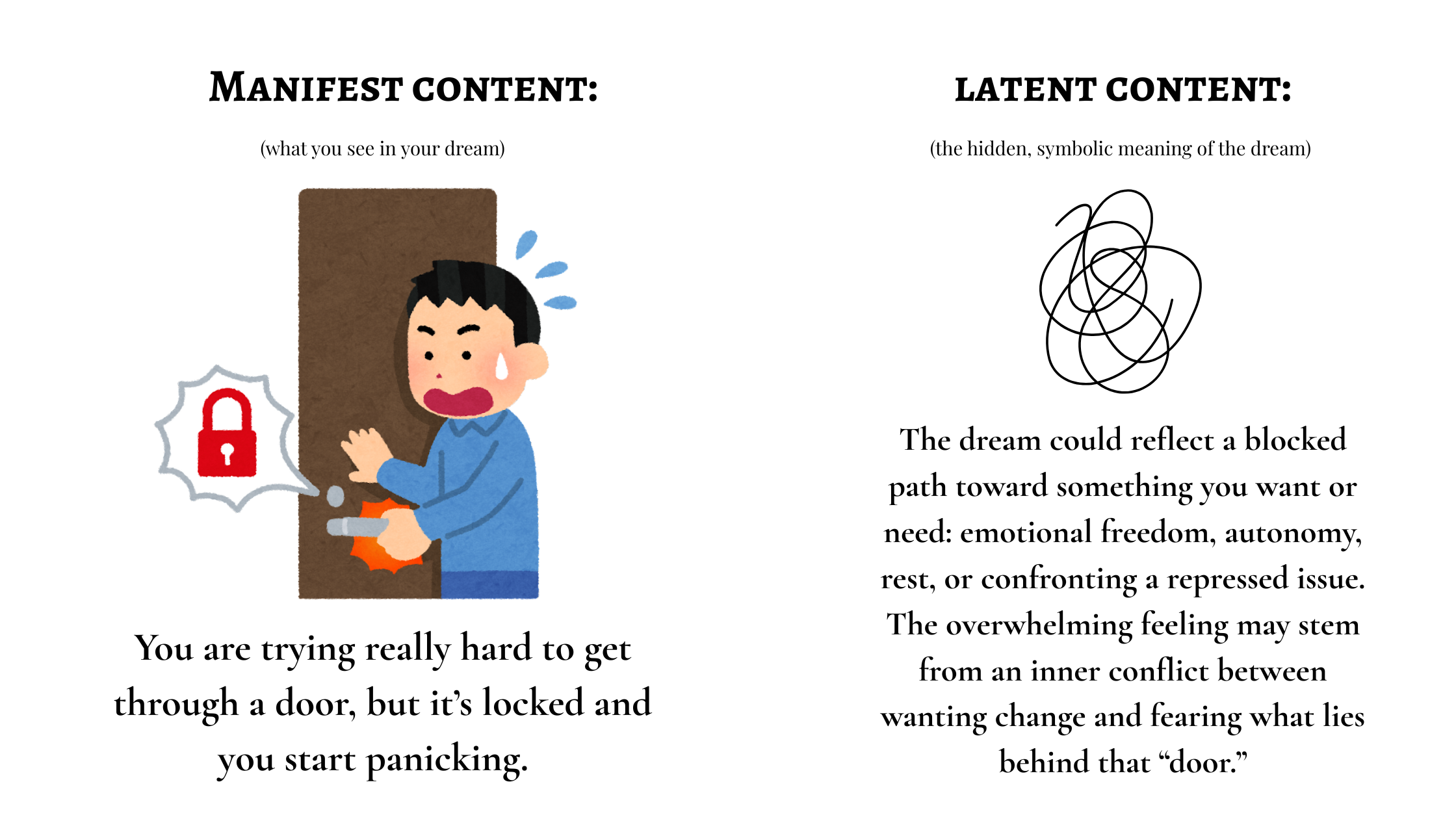
In his theory, dreams contain two key components:
1. Manifest content: The actual images and events in the dream.
2. Latent content: The hidden, symbolic meaning of the dream.
Neuroscience Theories
These theories suggest that dreams arise from patterns of brain activity, particularly those involved in processing emotions and consolidating memories. Neuroscientific approaches rely on empirical data and brain research to understand how and why dreaming occurs. Most of these theories do not assign symbolic meaning to dreams; instead, they view dreams as byproducts of neural processes taking place during sleep.
Cognitive and Information-Processing Theories
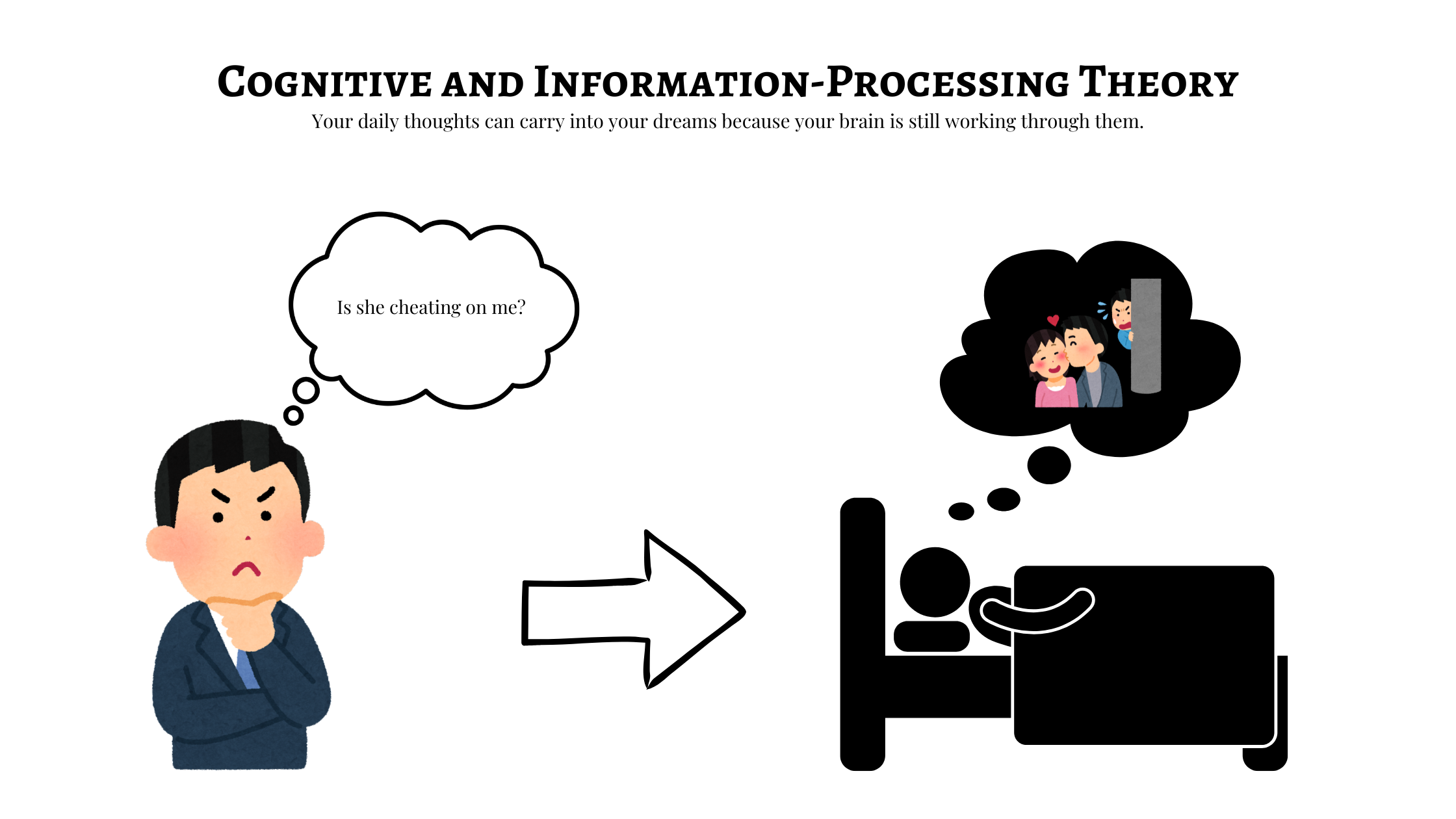
What sets this theory apart is that it views dream content as continuous with waking life concerns. It proposes that dreams are a byproduct of the brains processes during sleep. When you are dreaming, the theory believes you are really processing your memories, learning, and problem-solving.
Essentially, this theory says that dreams are connected to what you think about when you’re awake. Your brain keeps working while you sleep, sorting through your memories and solving problems. Dreams are basically your brain processing information from your day.
Evolutionary and Functional Theories
These theories propose that our dreams serve a purpose for survival or adaption.
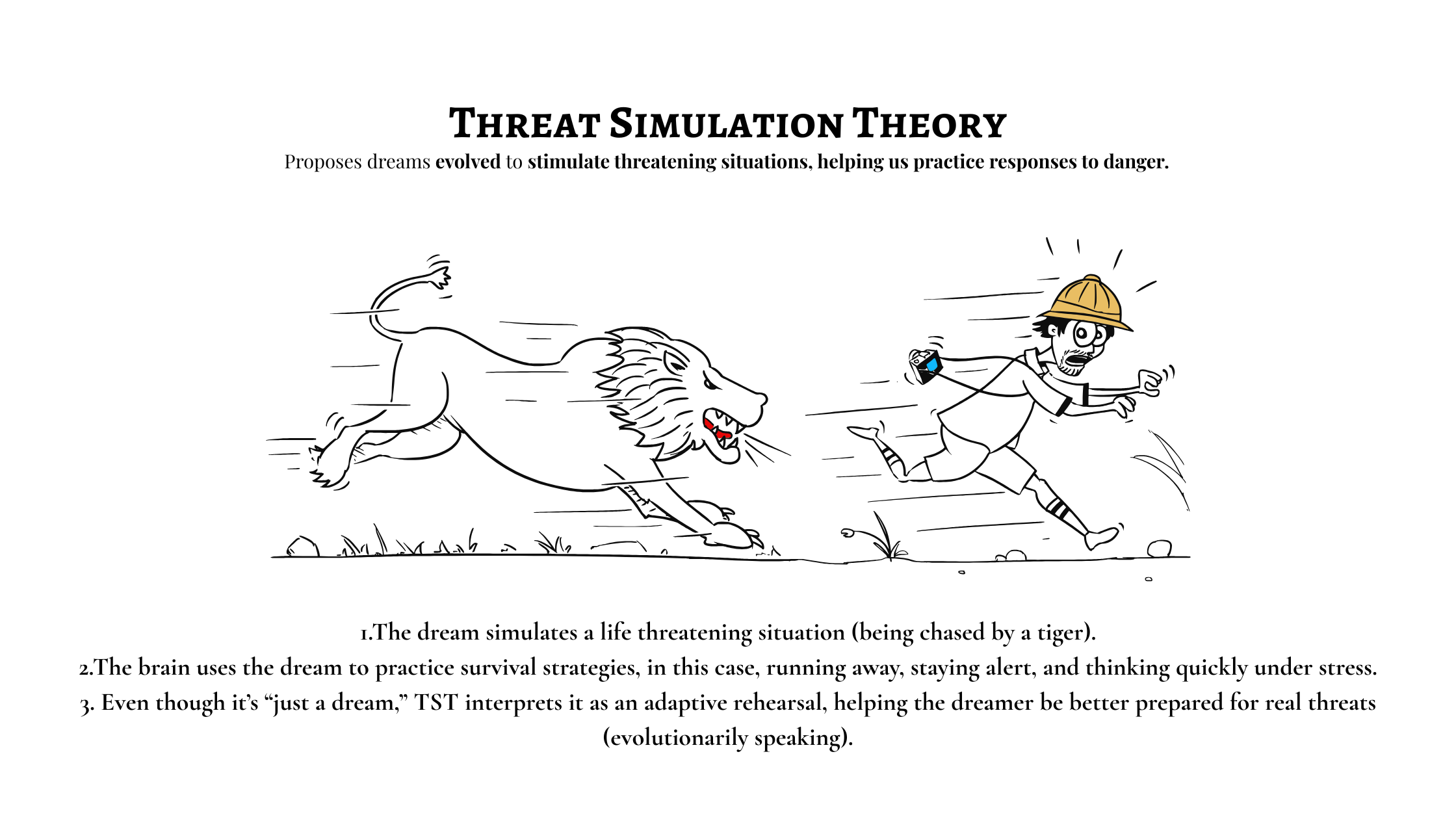
One major evolutionary theory includes: Threat Simulation Theory
This theory proposes dreams evolved to stimulate threatening situations, helping us practice responses to danger. This theory focuses on survival and adaptive functions, rather than symbolic meanings. You might be thinking, well if dreams evolved to stimulate dangerous situations, what is its position on delightful dreams? TST would suggest that “good dreams” aren’t adaptive, they are just byproducts of brain activity and have no evolutionary purpose.
How often do we dream?
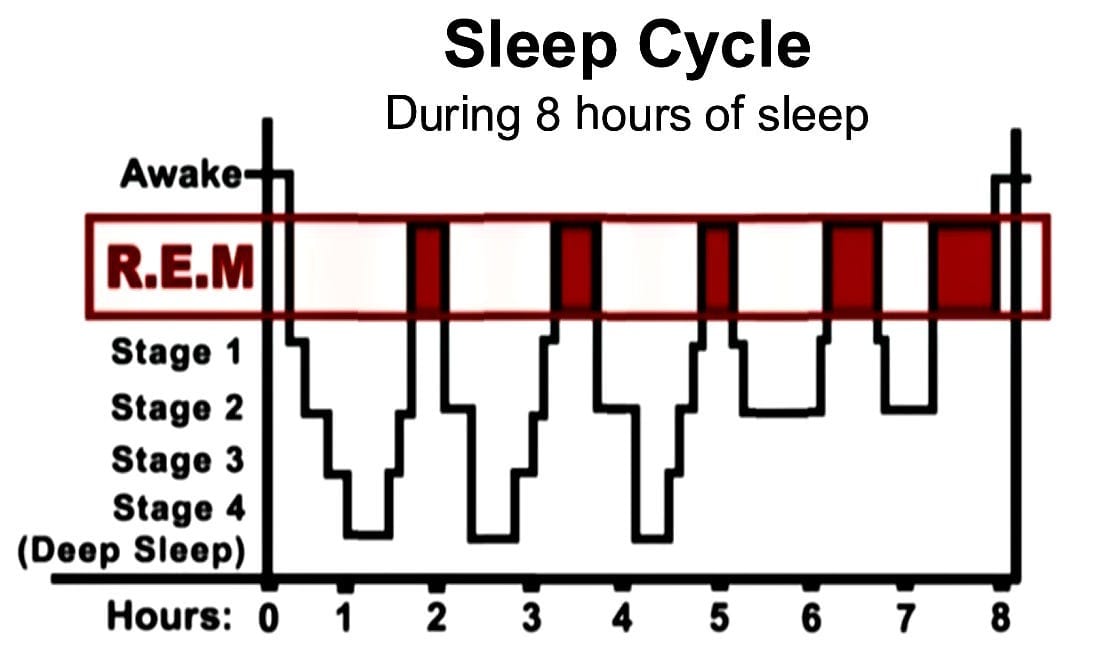
We spend on average two hours dreaming each night. Although our dreams can feel like seconds, they typically last from 5 to 20 minutes each. Research has shown that dreaming is closely associated with rapid eye movement (REM) sleep. It is known that dreaming also occurs during non-REM (NREM) sleep. Dreams during REM sleep tend to be longer, more vivid, more story-like, and more bizarre than those during non-REM sleep (Tsunematsu, 2022).
Fun fact: Newborns spend about half their sleep in REM sleep, suggesting they are experiencing some form of brain activity related to dreaming.
Why do we remember some dreams and not others?
When people say, “I never dream,” what they really mean is, they do not remember having dreamt.
A lot of dream recall simply depends on when you wake up during your sleep cycle. If you wake up during REM sleep (the stage when dreams are most vivid and active), you’re much more likely to remember them. If you wake up from deeper sleep stages, dream memories tend to fade before you’re fully awake.
You might also notice that you remember dreams more when you’re stressed or going through something emotionally difficult. Research from Scarpelli et al. (2022) shows that stressful or traumatic experiences can increase both dream recall and nightmares.
And going way back, Freud suggested that we forget dreams because our mind represses them, basically pushing them out of our awareness. In a more practical sense, this also makes sense: our brains can only hold on to so much information, and most dreams just aren’t important enough for our mind to store for later.
What do certain common symbols mean?
Jung stated the core function of our dreams is to show to our consciousness the hidden side of our psyche. The hard-to-understand images our mind creates while we are asleep are a representation of our suppressed desires and feelings. It is crucial to sit and think about these strange scenes. The better we understand them, the better we’ll understand ourselves.
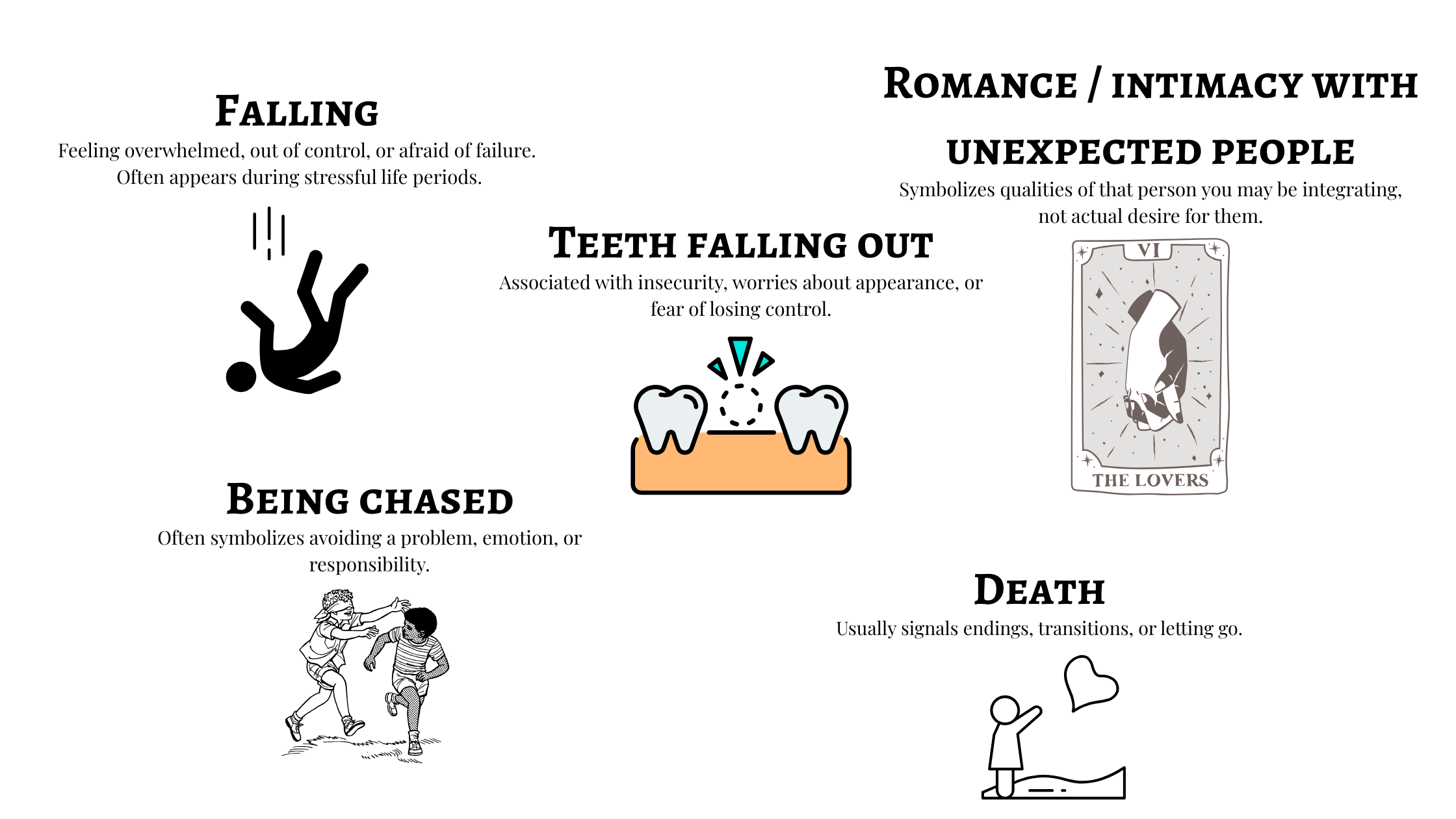
“A man’s dreams can reveal his true personality and his unconscious motives according to Jung. Yet, most of us, regardless of our background, reject the idea that these vague and unrealistic flashes of fantasy can say more about us than what they seem. The average man approaches dreams with ignorance. But the things we portray while we are asleep and the symbols we manifest arise from inner emotional disturbance. Making these emotions passing through the mind during sleep the chief source of knowledge about the person.”
Random food for thought:
While modern science can track when someone is dreaming, like identifying REM sleep, we still can’t project dreams onto a screen. In some ways, that’s a relief. Imagine if our dreams were available for review? Some of them are so strange, personal, and chaotic that having them recorded might feel invasive. But in other ways, being able to watch our dreams could be incredibly therapeutic. Dreams often reflect our emotions, unconscious fears, and unresolved thoughts. Seeing them clearly might help people understand themselves on a much deeper level.
Have you had any dreams lately that really stuck with you? What did you make of them?
Become a member for free and share in the comments!
References
Dennett, D. C. (1976). Are Dreams Experiences? The Philosophical Review, 85(2), 151. https://doi.org/10.2307/2183728
Scarpelli, S., Alfonsi, V., Gorgoni, M., & De Gennaro, L. (2022). What about dreams? State of the art and open questions. Journal of Sleep Research, 31(4). https://doi.org/10.1111/jsr.13609
Tsunematsu, T. (2022). What are the neural mechanisms and physiological functions of dreams? Neuroscience Research, 189(189). https://doi.org/10.1016/j.neures.2022.12.017
Winson, J. (1990). The Meaning of Dreams. Scientific American, 263(5), 86–97. https://www.jstor.org/stable/24996977